Getting Laser Treatments Safely in the Summer: What You Need to Know
One of the most common questions we hear during the warmer months is whether laser treatments should be avoided until fall or winter. For many years, patients were advised to wait until summer was over before considering laser skin rejuvenation. While that recommendation reflected the limitations of older technologies, today's approach is far more personalized.
Modern laser and light-based treatments allow many patients to improve their skin throughout the year, provided the right technology is selected and treatment is carefully planned. Success depends on understanding your skin, choosing the most appropriate treatment for your concerns, and protecting your skin before and after your procedure. In many cases, treatment settings can also be adjusted to provide noticeable skin rejuvenation while keeping recovery time to a minimum.
At One Point Six Aesthetics in Santa Cruz, we regularly help patients maintain healthy, vibrant skin throughout every season. Rather than waiting until fall to begin treatment, many patients benefit from a personalized approach that works around their lifestyle, their level of sun exposure, and their individual skin goals.
In this guide, we'll explain how practitioners determine whether summer laser treatments are appropriate, how different laser technologies are used to address different concerns, and why a customized treatment plan often produces the best long-term results.
Can You Have Laser Treatments During the Summer?
Yes. Many laser and light-based treatments can be performed safely during the summer with careful treatment planning and appropriate sun protection.
The biggest consideration isn't the weather. It's ultraviolet (UV) exposure. As the skin heals after treatment, it becomes more sensitive to the sun, making daily SPF and limiting UV exposure especially important.
Before recommending treatment, we assess:
Your skin type
Whether you have an active tan
Your history of pigmentation or melasma
The type and intensity of treatment
Your ability to protect your skin during recovery
The season is only one part of the decision. Choosing the right treatment depends on your skin, your lifestyle, and your treatment goals.
Which Laser Treatments Are Usually Suitable During Summer?
Once we've established that treatment can often be performed safely during summer, the next question becomes which technology is most appropriate.
Not every laser or light-based treatment works in the same way. Some are designed to improve pigmentation and redness, others stimulate collagen beneath the skin, while others resurface the skin to improve texture and more advanced signs of aging. Choosing the right technology begins with understanding the underlying cause of your concerns rather than simply selecting a device.
At One Point Six Aesthetics, we offer several advanced laser technologies because no single treatment is the best solution for every patient. During your consultation, we assess your skin and recommend the technology that is most likely to achieve your goals safely and effectively.
IPL (Intense Pulsed Light)
Although Intense Pulsed Light (IPL) is not technically a laser, it is one of the most effective treatments for improving concerns caused by excess pigment and visible blood vessels.
IPL delivers carefully controlled pulses of broad-spectrum light that are absorbed by unwanted pigment and vascular lesions while leaving the surrounding tissue largely unaffected. This makes it particularly effective for improving overall skin clarity with relatively little interruption to daily life.
IPL is commonly recommended for:
Sun damage
Age spots and freckles
Uneven pigmentation
Diffuse redness
Rosacea
Broken capillaries
Overall skin brightness
For patients whose primary concerns relate to sun damage, pigmentation, or redness, IPL is often one of the first treatments we recommend.
Harmony Laser
One of the most versatile systems available at One Point Six Aesthetics is the Alma Harmony Laser. Rather than being a single treatment, Harmony is a multi-platform system that combines several technologies within one device, allowing treatments to be customized according to each patient's skin concerns.
Depending on the handpiece selected, Harmony can be used to:
Improve pigmentation and sun damage using Dye-VL IPL
Reduce redness and visible blood vessels
Stimulate collagen with ClearLift®, helping improve fine lines and early skin laxity
Perform Pixel CO₂ fractional resurfacing to improve texture, acne scars, and overall skin renewal
Refresh overall skin quality by improving tone, smoothness, and radiance
This versatility allows treatment plans to evolve as your skin changes. Some patients benefit from a single Harmony treatment, while others combine different technologies over time to address multiple aspects of skin aging.
During the summer months, treatment settings can also be adjusted to prioritize gentle skin rejuvenation and shorter recovery periods, making it easier to fit treatment around work, travel, and everyday life.
How Does CO₂ Laser Resurfacing Improve Skin Quality?
While IPL is designed to improve pigmentation and redness, CO₂ laser resurfacing focuses on improving skin texture and stimulating collagen production. By creating thousands of microscopic treatment zones within the skin, it triggers the body's natural healing response, renewing the skin's surface while encouraging long-term collagen remodeling.
CO₂ resurfacing is commonly used to improve:
Fine lines and wrinkles
Acne scars
Uneven skin texture
Enlarged pores
Sun-damaged skin
Overall skin smoothness
At One Point Six Aesthetics, we offer Edge Polish, our lighter CO₂ resurfacing treatment. Similar in concept to a CoolPeel® treatment, Edge Polish delivers smoother, brighter skin with minimal downtime, making it an excellent option for patients who want noticeable skin rejuvenation without a lengthy recovery.
For deeper wrinkles, more advanced sun damage, or significant acne scarring, a more intensive CO₂ resurfacing treatment may be recommended. During your consultation, we'll determine the most appropriate approach based on your skin, lifestyle, and treatment goals.
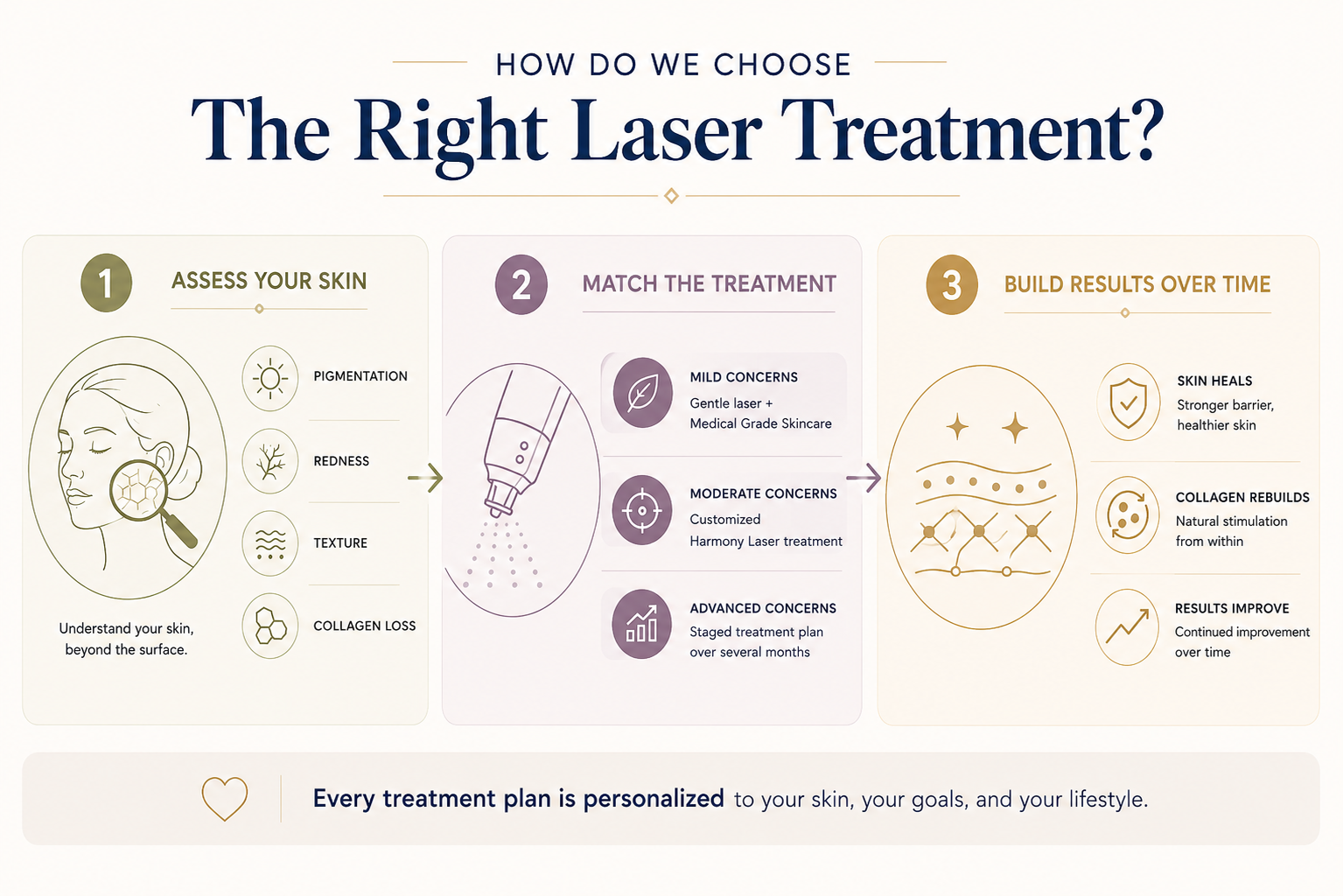
How Do Practitioners Decide Which Laser Treatment Is Best?
Choosing the right laser treatment begins with understanding your skin rather than simply treating what you can see. A personalized assessment helps determine which technology, or combination of treatments, is most appropriate for your concerns and goals.
Why Medical Grade Skincare Matters Before and After Laser Treatments
Laser treatments are only one part of improving skin quality. Healthy skin responds more predictably to treatment, recovers more efficiently, and maintains improvements for longer. This is why Medical Grade Skincare is an important part of many laser treatment plans.
Unlike over-the-counter products, medical-grade skincare contains clinically active ingredients in concentrations designed to support specific biological processes within the skin. Following a skin assessment, products are selected according to your skin type, concerns, and treatment goals rather than following a one-size-fits-all routine.
Before laser treatment, Medical Grade Skincare may be used to:
Strengthen the skin barrier
Improve hydration
Support healthy cell turnover
Reduce inflammation
Prepare the skin for treatment
Following laser procedures, an appropriate skincare routine helps protect the healing skin, supports recovery, and maintains the improvements achieved through treatment.
In our experience, patients who combine laser treatments with a consistent home skincare routine often enjoy healthier skin and longer-lasting results than those who rely on procedures alone.
What About Sun Damage After Summer?
As summer draws to a close, many people begin noticing pigmentation, uneven skin tone, rough texture, and fine lines becoming more visible as their tan gradually fades. Although these changes develop gradually over many years, they often become more noticeable once the surrounding skin returns to its natural color.
Because UV exposure affects multiple layers of the skin, treating sun damage usually involves more than a single procedure. Surface pigmentation, collagen loss, textural change, and skin quality are all different processes, which is why treatment plans are often designed to address each concern individually.
Depending on your skin assessment, your treatment plan may include:
Harmony Laser to target pigmentation, redness, sun damage, uneven skin tone, and improve overall skin clarity.
PRX Plus to brighten and rejuvenate the skin without significant peeling, making it an excellent option for minimal downtime.
Microneedling to stimulate collagen production, improve skin texture, refine enlarged pores, and support natural skin renewal.
PRF (Platelet-Rich Fibrin) to encourage tissue repair and regeneration using your body's own growth factors, supporting healing and collagen production.
Radiesse® to stimulate new collagen production and improve skin firmness and structural support from within.
Sculptra® to gradually restore collagen, improving skin quality and helping address age-related volume loss over time.
Dermal Fillers, where appropriate, to restore facial volume and rebalance facial contours that may have changed through aging or collagen loss.
Rather than treating every concern at once, practitioners build treatment plans step by step. This allows each treatment to perform its specific role while creating healthier skin and more natural-looking results that continue to improve over time.
Frequently Asked Questions
Can I wear sunscreen immediately after laser treatment?
Your practitioner will advise when sunscreen can be safely applied. Once appropriate, a broad-spectrum SPF becomes one of the most important parts of protecting your skin and maintaining your results.
Does summer humidity affect laser treatment results?
Humidity itself does not reduce the effectiveness of laser treatments. However, excessive heat and sweating immediately after treatment may increase skin sensitivity during the early stages of healing.
Can I swim after laser treatment?
Swimming pools, hot tubs, lakes, and the ocean are usually avoided until the skin has fully recovered, as freshly treated skin is more susceptible to irritation.
Can laser treatments be combined with other treatments?
Yes. Many patients achieve the best results by combining laser treatments with Medical Grade Skincare, Microneedling, PRF, PRX Plus, or collagen-stimulating treatments such as Radiesse® or Sculptra®. The most appropriate combination depends on your skin concerns, treatment goals, and the amount of downtime you can accommodate.
Is it better to have several gentle laser treatments or one stronger treatment?
The answer depends on your skin concerns and your goals. Some patients benefit from a series of gentler treatments that gradually improve skin quality with minimal recovery, while others achieve better results with more intensive resurfacing. Your practitioner will recommend the approach that is most appropriate for your skin.
Can laser treatments help prevent visible signs of aging?
Laser treatments cannot stop the natural aging process, but they can stimulate collagen production, improve skin quality, reduce the visible effects of sun damage, and help maintain healthier-looking skin over time.
Which Laser Treatment Is Right for You?
There is no single laser treatment that is right for everyone. The most appropriate technology depends on your skin type, the concerns you want to address, your lifestyle, the amount of recovery time you can accommodate, and your long-term goals.
For some patients, IPL is the most effective choice for improving pigmentation, redness, and visible sun damage. Others benefit from collagen-stimulating treatments such as ClearLift®, while patients looking to improve skin texture, acne scars, or more advanced signs of aging may achieve better results with CO₂ resurfacing or Edge Polish. In many cases, the best outcomes come from combining laser treatments with therapies such as Medical Grade Skincare, PRX Plus, Microneedling, PRF, Radiesse®, or Sculptra® as part of a personalized treatment plan.
The best laser treatment isn't the newest technology or the strongest setting. It's the one that's chosen specifically for your skin, your concerns, and your goals.
The best way to determine which treatment is right for you is through a comprehensive consultation. At One Point Six Aesthetics in Santa Cruz, we take the time to assess your skin, understand your concerns, and recommend the technology and treatment plan that will deliver the safest, most effective, and most natural-looking results.
Book a consultation to discover which laser treatment is best suited to your skin and begin a personalized treatment plan designed around your individual goals.