Perimenopause and Skin Changes: Treatment Options That Help
If your skincare routine has not changed but your skin suddenly seems drier, thinner or less predictable, perimenopause may be part of the explanation.
For some women, the first changes are subtle. Makeup no longer sits quite as smoothly. Fine lines become more noticeable, particularly around the eyes and mouth. Skin that previously felt resilient may become dry or sensitive. Over time, there can also be changes in firmness, facial volume, pigmentation and overall texture.
These changes are not simply about getting older. During perimenopause, fluctuating hormone levels can affect many of the processes responsible for maintaining healthy skin.
At One Point Six Aesthetics in Santa Cruz, we look at what has actually changed within the skin rather than treating "perimenopausal skin" as one concern. Someone experiencing dryness and dullness needs a very different approach from someone noticing significant collagen loss, laxity or facial hollowing.
Understanding those differences is the starting point.
What Happens to Your Skin During Perimenopause?
Perimenopause is the transitional period leading up to menopause, when hormones such as estrogen begin to fluctuate and eventually decline. Because estrogen plays an important role in collagen production, hydration, skin thickness and elasticity, these hormonal shifts can gradually change how the skin looks and feels.
You may start to notice:
Increased dryness or dehydration
Fine lines becoming more visible
Reduced firmness and elasticity
Thinner or more fragile-feeling skin
Uneven texture or pigmentation
Changes in facial fullness or contour
Greater sensitivity to products
For some women, these changes can seem to happen surprisingly quickly. Usually, however, it is several smaller changes becoming noticeable at the same time. Reduced hydration can make fine lines look more pronounced, while declining collagen can affect firmness and elasticity. Existing sun damage may become more obvious, and normal age-related changes in facial fat and structural support can begin to alter facial contours.
Not every change is caused by hormones alone. Genetics, cumulative sun exposure, lifestyle, skincare history and natural facial aging are all occurring alongside perimenopause. This is why two women at the same stage of perimenopause can have very different skin concerns.
It also explains why simply switching to a richer moisturizer may not address everything you are seeing. Skincare remains important, particularly for dryness, sensitivity and barrier support, but changes involving collagen, pigmentation, texture or facial support may require a different approach.
The important question is therefore not simply, “How do I treat perimenopausal skin?” but “What has actually changed in my skin, and what is driving it?” That distinction helps determine which treatment, if any, is likely to be useful.
Which Treatments Can Help Perimenopausal Skin?
There is no single best treatment for perimenopausal skin changes. Some women mainly notice dryness, fine lines and uneven texture, while others see pigmentation, loss of firmness, thinning skin or changes in facial contours.
At One Point Six Aesthetics, we look at which of these changes is most prominent and choose treatment accordingly.
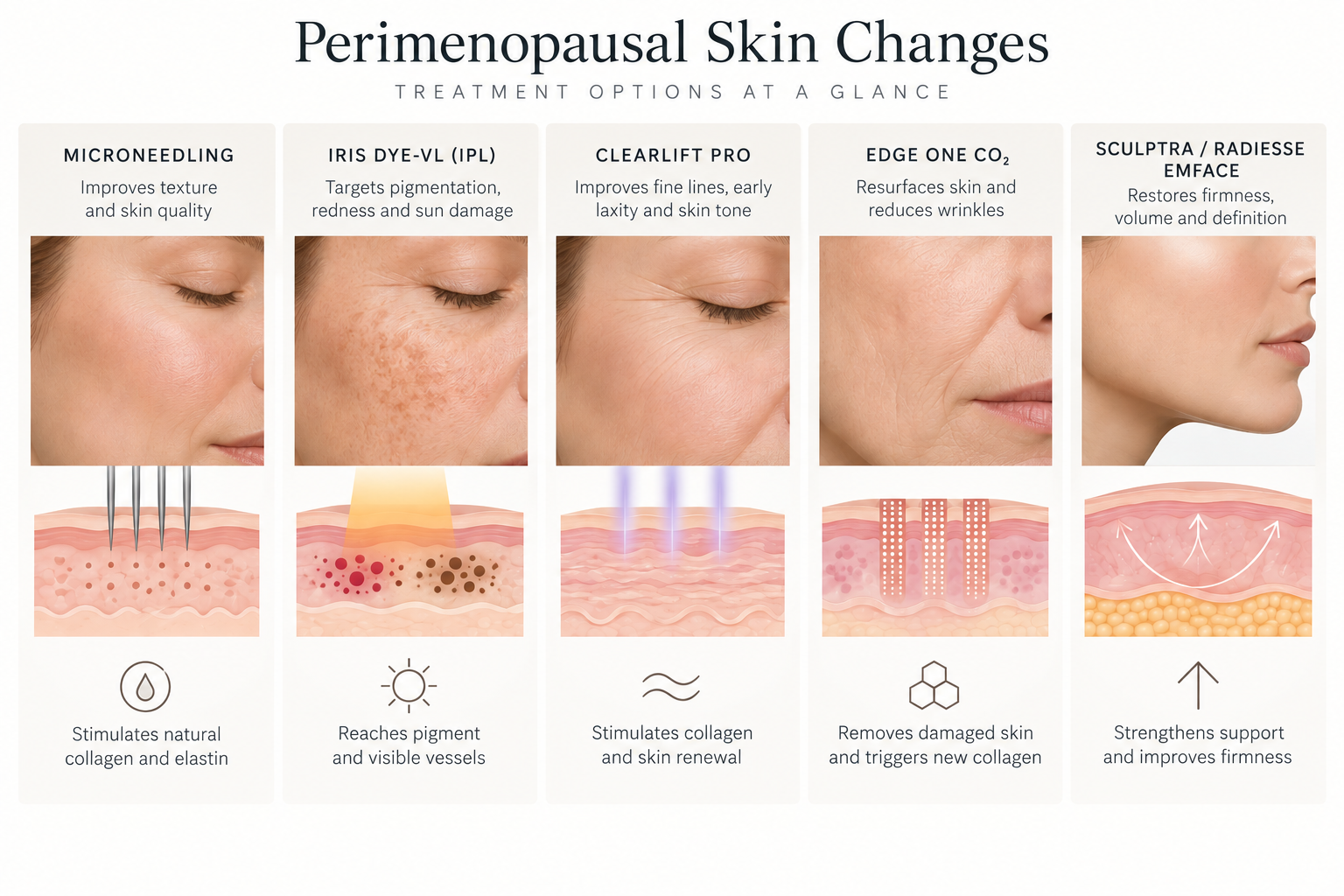
For Early Texture Changes: Microneedling
Microneedling can be a useful starting point for relatively mild changes such as uneven texture, fine lines, enlarged-looking pores and declining skin quality.
The treatment creates controlled micro-injuries that stimulate the skin's natural repair response and encourage new collagen and elastin. The focus is on improving the quality and resilience of the skin rather than adding volume or changing facial contours.
Microneedling can also be combined with Platelet-Rich Fibrin (PRF). PRF is produced from the patient's own blood and contains platelets and growth factors that support tissue repair and collagen production. Depending on the concern, it can be used alongside microneedling, applied topically or injected directly.
For Pigmentation, Redness and Sun Damage: Iris Dye-VL and ClearLift Pro
Years of UV exposure can become increasingly visible during the same period as hormonal skin changes, particularly as brown spots, freckles, uneven pigmentation and redness.
The Alma Harmony platform gives us different ways to address these concerns. Iris Dye-VL (IPL) targets pigmentation, sun spots, freckles, redness and visible vascular changes. ClearLift Pro may be considered when pigmentation occurs alongside fine lines, early laxity and declining collagen.
Choosing between them depends on what is causing the discoloration, as well as skin type and recent sun exposure. Not all pigmentation responds to the same treatment, so assessment is particularly important before using laser or light-based technology.
For More Established Texture and Wrinkles: Edge ONE CO₂
When wrinkles, rough texture or photodamage are more established, Edge ONE CO₂ laser can provide a more intensive resurfacing treatment.
The fractional CO₂ laser creates microscopic treatment zones within the skin, removing damaged surface tissue while stimulating repair and new collagen formation. This makes it more appropriate when the changes extend beyond mild dullness or early textural concerns.
The trade-off is recovery. CO₂ resurfacing generally involves more downtime than microneedling, ClearLift Pro or IPL, so stronger treatment is not automatically better. The intensity needs to reflect both the condition of the skin and the level of recovery you are comfortable with.
For Collagen Loss and Crepey Skin: Sculptra and Radiesse
When reduced collagen is showing as thinning skin, loss of firmness, hollowing or reduced facial support, biostimulatory treatments may be more relevant than resurfacing alone.
Sculptra contains poly-L-lactic acid and stimulates the body's own collagen production over time. Rather than simply filling an individual line, it can help address broader changes in facial support and collagen. Results develop progressively as new collagen forms.
Radiesse contains calcium hydroxylapatite and also has collagen-stimulating properties. When hyperdiluted, it can be used with a greater focus on improving firmness, elasticity and crepey skin rather than adding significant volume. Areas such as the neck and décolletage can particularly benefit when thinning and laxity have become more noticeable.
For Reduced Facial Tone and Definition: Emface
Changes in the face are not always limited to the skin. Muscle tone and deeper facial support can also influence how firm or defined the face appears.
Emface combines facial muscle stimulation with collagen remodeling and may be considered when early sagging, reduced definition or declining facial tone are becoming noticeable.
This addresses a different component of facial aging from resurfacing or pigment treatment. For some patients, one treatment may be sufficient. For others, perimenopause coincides with several changes at once, and a staged approach can address texture, pigmentation, collagen loss or facial support separately rather than expecting one procedure to do everything.
Should You Consider Hormones for Perimenopausal Skin Changes?
Skin changes can be one part of a much broader perimenopausal picture.
Hot flashes, sleep disturbance, mood changes, vaginal dryness and other symptoms may occur alongside changes in the skin. One Point Six also offers physician-supervised hormone optimization using bioidentical hormone pellets.
However, hormone therapy should not be viewed simply as a cosmetic skin treatment.
If symptoms suggest a wider hormonal issue, the appropriate next step is a medical assessment. At One Point Six, hormone optimization begins with an in-depth consultation and hormonal assessment, with treatment and ongoing monitoring determined according to the individual.
Similarly, someone seeking treatment solely for pigmentation or texture should not assume that hormone therapy is required. These are separate decisions that need to be made for the right clinical reasons.
FAQs About Perimenopause and Skin Changes
Can perimenopause cause acne even if I never had acne before?
Hormonal fluctuations can coincide with changes in oil production and breakouts in adulthood. New or persistent acne should still be properly assessed rather than automatically attributed to hormones, particularly if it develops suddenly or is accompanied by other symptoms.
Why has my usual skincare started irritating my skin?
Skin can become drier and more reactive during this stage of life. Products or active ingredients that you previously tolerated may suddenly feel too strong. Rather than adding more actives, it may be worth reassessing your routine and concentrating on barrier support and appropriate medical-grade skincare.
Can perimenopause affect the skin on my neck and chest too?
Yes. Changes in collagen and elasticity are not limited to the face. The neck and décolletage may develop increased crepiness, fine lines and laxity, particularly where there has also been significant lifetime sun exposure. Hyperdilute Radiesse is one option offered at One Point Six for improving skin quality in these areas.
Does perimenopausal skin need more aggressive treatments?
Not necessarily. Treatment intensity should be determined by the condition being treated, not your age or hormonal stage. Mild changes may respond well to skincare and less intensive collagen stimulation, while more established wrinkles, laxity or photodamage may justify a different approach.
When should I start treating perimenopausal skin changes?
There is no particular age at which aesthetic treatment becomes necessary. If changes are beginning to bother you, an assessment can help establish what is happening and whether treatment would genuinely be useful. Preventive skincare and daily sun protection remain important regardless of whether you choose an in-office procedure.
A More Individual Approach to Changing Skin
Perimenopause can change how your skin looks, feels and responds, but it does not create the same pattern of aging in every woman.
The most useful treatment plan is therefore rarely based on perimenopause alone. It should consider collagen, texture, pigmentation, facial volume, muscle tone, sun damage and overall skin health separately, then concentrate on the changes that matter to you.
If you are noticing perimenopausal skin changes and are unsure whether skincare, microneedling, laser treatment, collagen stimulation or another approach is appropriate, you can book a consultation with One Point Six Aesthetics in Santa Cruz, California. We can assess your skin and create a treatment plan based on its current condition rather than following a one-size-fits-all approach.