CO2 Laser Around the Eyes: Can It Tighten Crepey Skin and Fine Lines?
The skin around the eyes is thinner than skin across much of the face, which is one reason changes in this area can become noticeable relatively early. As collagen and elastin gradually decline, repeated facial movement and years of sun exposure can make fine lines, crepey texture and more deeply etched wrinkles increasingly visible.
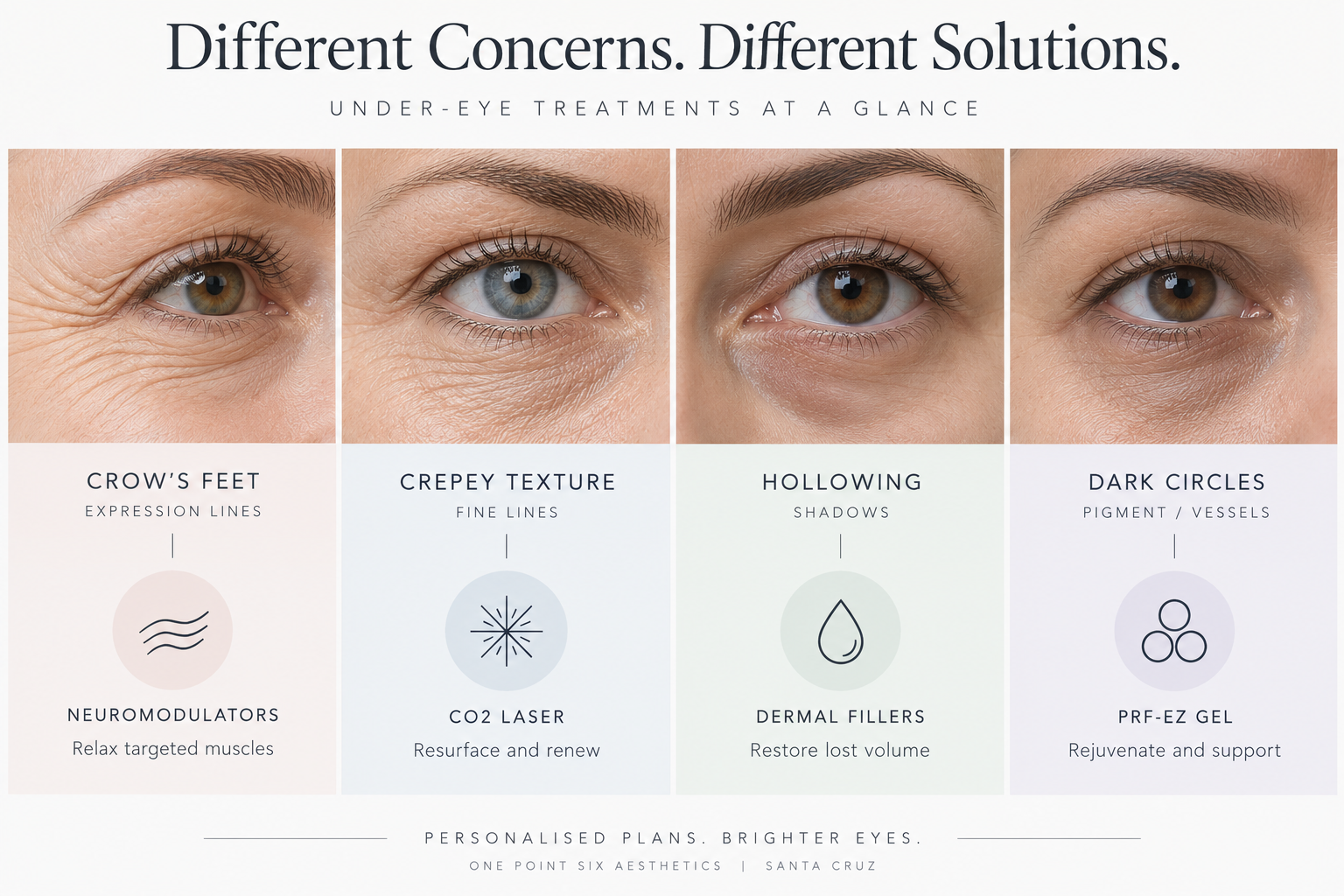
But not every change around the eyes comes from the skin itself. Under-eye hollows can create shadows, muscle movement contributes to crow's feet, and changes in facial volume can affect support around the lower eyelid. This distinction matters because CO2 laser around the eyes primarily treats the skin. It cannot replace lost volume or address every cause of a tired-looking eye area.
At One Point Six Aesthetics in Santa Cruz, we use Edge ONE CO2 laser resurfacing when the concern is related to skin texture, fine lines and firmness. Here, we look at what happens to the skin around the eyes, how CO2 resurfacing works and when another treatment may be more appropriate.
Why Does the Skin Around Your Eyes Age So Quickly?
The eye area is constantly moving. Every blink, smile and squint places repeated mechanical stress on skin that is already relatively thin. Over time, declining collagen and elastin mean that the skin does not recover from this movement as effectively as it once did.
UV exposure can accelerate these changes by contributing to collagen breakdown and photodamage. This is why the outer eye area in particular can develop visible lines and changes in texture.
You may begin to notice:
Fine lines around or beneath the eyes
Crow's feet that remain visible when your face is relaxed
Thin or crepey-looking skin
Rougher texture
Reduced firmness
Visible sun damage
These changes are different from a deep tear trough or under-eye hollow. If the shadow beneath the eye is being created by changes in facial structure or volume, resurfacing the surface of the skin cannot correct the underlying cause.
What Is CO2 Laser Resurfacing?
A CO2 laser is an ablative resurfacing laser that uses a 10,600 nm wavelength. This wavelength is strongly absorbed by water, which makes up a significant proportion of skin tissue.
At One Point Six Aesthetics, we use Jeisys Edge ONE for CO2 laser resurfacing. By precisely delivering laser energy into the skin, controlled areas of older or damaged tissue can be removed while heat is delivered into the tissue below. The resulting healing response encourages skin renewal and collagen remodeling. This is what makes CO2 different from treatments that work by adding volume or relaxing muscle movement. It is designed to create a controlled change within the skin itself.
How Does CO2 Laser Work Around the Eyes?
The science behind CO2 resurfacing is particularly relevant to the eye area.
Because the laser's 10,600 nm wavelength is readily absorbed by water in the skin, its energy can be used to precisely vaporize microscopic areas of tissue. At the same time, controlled heat spreads into the surrounding tissue.
These two effects perform different jobs. The ablative effect removes areas of damaged surface tissue, prompting the epidermis to renew as the skin heals. This is particularly relevant to rough texture and fine lines. The thermal effect acts deeper within the dermis, where collagen provides much of the skin's structural support. Heat causes an immediate contraction of existing collagen fibers and initiates a wound-healing response. Fibroblasts, the cells responsible for producing collagen and other components of the extracellular matrix, become active during this repair process.
New collagen is then produced and existing collagen reorganized over the following weeks and months. This gradual remodeling is responsible for much of the improvement in firmness and texture that develops after the initial healing period.
Around the eyes, precision is particularly important. Eyelid and periorbital skin is delicate, so treatment depth, density and intensity must be adjusted carefully, with appropriate eye protection used throughout treatment.
CO2 resurfacing is therefore particularly relevant when wrinkles have become static, meaning they remain visible when the face is relaxed. At this point, the line is not being created by muscle movement alone. Structural changes have also developed within the skin.
Is CO2 Laser Good for Crepey Under-Eye Skin?
Crepey under-eye skin is one of the concerns for which resurfacing may be considered because the problem exists within the skin itself.
When the skin becomes thinner and less resilient, it can develop a finely wrinkled appearance that is particularly noticeable when smiling or applying makeup. Adding volume beneath the area does not necessarily improve this surface texture.
CO2 laser instead aims to renew the surface and remodel the supporting collagen beneath it. Treatment intensity still needs to reflect the condition of the skin. Mild textural changes may not require aggressive resurfacing, while more established lines and visible photodamage may justify a more corrective approach.
The aim is not to make the eye area look artificially tight. It is to create smoother, stronger-looking skin while maintaining natural movement.
Can CO2 Laser Get Rid of Under-Eye Wrinkles?
CO2 laser can soften under-eye wrinkles, but complete removal is not a realistic or useful treatment goal. The important question is what is causing the wrinkle.
A line that appears predominantly when you smile is strongly influenced by contraction of the muscles around the eye. In this situation, neuromodulators may be more directly suited to the movement creating the line.
A wrinkle that remains visible when your face is relaxed has developed a static component. The skin itself has changed, which is where resurfacing becomes more relevant.
Many patients have a combination of the two. They may have dynamic crow's feet when smiling alongside finer etched lines that remain visible at rest. Treatment can therefore depend on how much of the concern comes from muscle movement and how much comes from changes within the skin.
When Is CO2 Laser Not the Answer for Tired-Looking Eyes?
CO2 laser is a skin resurfacing treatment, so it is important not to expect it to correct every feature of the eye area.
Under-eye hollows can create shadows. Volume changes can affect support beneath the lower eyelid. Pigmentation or visible blood vessels may contribute to dark circles, while repetitive muscle activity can produce dynamic crow's feet.
These concerns can look similar at first glance, but they have different causes.
At One Point Six, under-eye rejuvenation is therefore based on what is actually creating the concern. PRF-EZ Gel, for example, may be considered for concerns including crepey texture, fine lines, dark under-eyes and early volume loss. Where hollowness is a more significant component, carefully selected dermal fillers may have a different role.
In practice, the question is not simply which treatment can be used around the eyes. It is which tissue or structure needs treating in the first place.
FAQs About CO2 Laser Around the Eyes
What age should you start CO2 laser around the eyes?
There is no specific age at which CO2 laser becomes appropriate. Treatment is based on the condition of the skin rather than a birthday. Someone with significant photodamage or established etched lines may consider resurfacing earlier than another person of the same age whose skin has very little textural change.
Can CO2 laser make under-eye bags disappear?
Not necessarily. An under-eye "bag" may involve skin laxity, prominent fat, fluid or anatomical changes beneath the eye. CO2 laser can improve the quality and firmness of the skin, but it cannot correct every cause of under-eye bags.
Does CO2 laser help dark circles?
It depends on why the area appears dark. If changes in skin quality are contributing, resurfacing may have a role. Dark circles can also be caused by pigmentation, visible blood vessels, hollowing or shadows created by facial anatomy, which may require a different approach.
How long do CO2 laser results around the eyes last?
The collagen remodeling and skin renewal created by treatment can provide lasting improvement, but the skin will continue to age. UV exposure also continues to affect collagen over time, making daily sun protection and appropriate skin care important after treatment.
Can you have CO2 laser if you have had Botox or filler?
Previous injectable treatment does not automatically prevent someone from having CO2 resurfacing. However, the timing, location and type of previous treatment need to be considered when planning laser treatment. Your provider should therefore know about any recent Botox, filler or other aesthetic procedures.
Is CO2 Laser Right for Your Eye Area?
The eye area is small, but what creates an aged or tired appearance can involve several different structures. Fine lines and crepey skin may point towards changes within the skin, while hollowness, shadows and dynamic wrinkles can have different causes.
At One Point Six Aesthetics in Santa Cruz, California, we assess these features together before recommending treatment. This helps determine whether Edge ONE CO2 resurfacing is appropriate or whether another approach would better address what you are seeing.
If you are noticing increasingly crepey under-eye skin, etched lines or changes in texture, book a consultation to have the area assessed and discuss whether CO2 laser resurfacing is appropriate for your skin.